Marketing Agency or Freelancer: Who Should You Choose to Promote Your Business?
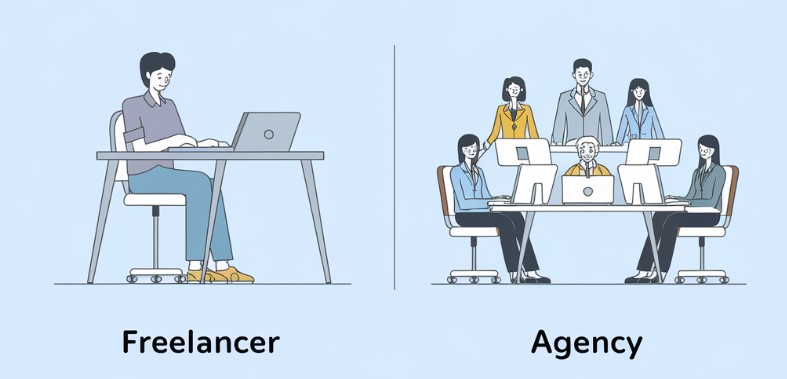
When it comes to growing a business online, choosing a contractor for website development and promotion is one of the most crucial decisions that can significantly impact future success. Today, companies can choose between working with a marketing agency or collaborating with freelancers. Both options have their pros and cons, and the right choice depends on the unique characteristics of the business, its needs, and budget.
Ultimately, the decision between an agency and a freelancer depends on various factors such as project complexity, available budget, and the need for a comprehensive approach. Let’s begin by reviewing the benefits and drawbacks of partnering with a marketing agency.
1. Advantages of Working with a Marketing Agency

1.1 Team of Specialists
One of the greatest advantages of working with a marketing agency is having access to a team of specialists who are experts in different areas of online marketing. An agency is composed of professionals, each with their own expertise and experience in a specific field, ensuring quality execution at every stage of the project. For instance, agencies typically include developers, designers, SEO, SMM specialists, PPC experts, and content managers.
This approach helps avoid situations where a single freelancer tries to handle all aspects of the project, which could lead to a decline in quality in certain areas. For example, an SEO specialist in an agency will focus solely on search optimization, while a designer will work on the visual part of the website without being distracted by technical tasks. This ensures high quality at all stages since each aspect is handled by a dedicated expert who knows their craft.
Additionally, agencies have access to professional tools and analytical platforms that help them assess campaign effectiveness, test different approaches, and make quick adjustments. This greatly increases the chances of success for marketing campaigns and allows clients to receive clear reports on the results of their work.
1.2 Comprehensive Approach
A marketing agency provides a comprehensive approach to promoting a business, which is one of its key advantages. Every project is coordinated across different departments within the agency, ensuring the integrity of the strategy and its alignment with the client’s business goals. For example, the SEO, PPC, and content marketing strategies are developed together, considering the interrelationships between different promotion channels.
Coordination between departments helps avoid conflicts or contradictions among different marketing tools, as all teams work in a unified environment and collaboratively implement the strategy. This is crucial for achieving maximum impact from campaigns since every tool’s use is reinforced by other aspects like SEO, content, Google Shopping and target.
A holistic approach allows agencies to see the bigger picture of the client’s business and offer solutions that go beyond simple ad campaigns. They analyze the target audience, create a consistent brand message, and integrate various communication channels to maximize efficiency. This approach is significantly different from working with a freelancer, who usually executes only specific tasks and may not have the capacity to consider all aspects of an overarching marketing strategy.
1.3 Systematic and Scalable Solutions
Another important advantage of working with a marketing agency is its ability to provide systematic and scalable solutions for projects. Agencies are equipped to work with both small businesses and large projects, thanks to their ability to quickly bring in additional resources when needed. For instance, if the project expands or there is a need to intensify campaigns across different channels, the agency can swiftly involve extra specialists, increase the budget, or adjust the strategy accordingly.
This capability is especially important for businesses planning rapid growth or entering new markets. Through a systematic approach, an agency can organize a long-term promotion strategy that includes market analysis, competitor research, testing different marketing tools, and preparing large-scale campaigns. This helps avoid chaotic actions and ensures steady business development.
1.4 Experience and Case Studies
The experience of a marketing agency is another significant advantage that helps businesses achieve better results. Agencies usually have an extensive portfolio of successful case studies, covering work in various industries from small businesses to large corporations. This allows them to accumulate knowledge and understand the specifics of different markets while effectively adapting their strategies to each client.
Furthermore, experience working across diverse industries allows agencies to quickly understand the needs of a particular business and provide the best possible solutions. For instance, an agency experienced in e-commerce can suggest effective strategies for improving conversion rates, while an agency with a background in service industries will focus on building trust and attracting new clients. Such broad experience enables agencies to adapt their approaches effectively and provide tailored solutions for each client.
2. Advantages of Working with a Freelancer

2.1 Cost-Effectiveness
One of the most significant advantages of working with a freelancer is cost-effectiveness. The cost of hiring a freelancer is often lower than that of a marketing agency, as freelancers do not have overhead expenses such as office rent, administrative costs, or the need to maintain a large team. As a result, working with a freelancer can be a financially advantageous option for small businesses or startups with limited budgets.
Moreover, freelancers often offer flexible payment terms, such as hourly rates or a fixed amount for a specific scope of work. This allows clients to better manage their expenses and avoid unexpected costs. For many businesses, especially in the early stages of growth, this aspect is crucial as it enables them to get the necessary services at a reasonable price without unnecessary expenses.
2.2 Flexibility in Task Execution
Freelancers are often known for their high flexibility in task execution, which is a major benefit for many businesses. They can quickly respond to specific client requests and make changes to the project on short notice, which is especially valuable when there is a need to adapt swiftly to new circumstances or market changes. The absence of bureaucratic processes common in larger organizations allows freelancers to work without unnecessary delays, often speeding up task completion.
Flexibility also extends to the ability to align the freelancer’s work schedule with the client’s needs. For example, a freelancer can work outside of regular hours or during weekends if required to meet a project’s urgent deadline. This allows businesses to obtain the needed results quickly without being tied to a standard work schedule, which is a significant advantage in a dynamic environment.
2.3 Personal Approach
Freelancers often provide a personal approach to working with clients, which is one of their key advantages. Since freelancers typically work independently without a large team, they can focus on the direct needs of the client and provide individualized service. Direct communication without intermediaries allows clients to clearly convey their requirements and receive prompt responses to their questions.
Freelancers can build long-term relationships with clients based on mutual understanding and a deep knowledge of the business’s needs. Due to direct communication, a freelancer can quickly understand what changes need to be made or how best to adapt a project to meet the client’s current requirements. This is especially important for small companies that require a personalized approach and particular attention to detail.
3. Key Drawbacks of Working with a Freelancer

3.1 Limited Skill Set
One of the main drawbacks of working with a freelancer is their limited skill set. Freelancers usually specialize in only one or a few areas, which can become a problem when a project requires a comprehensive approach. For instance, a freelancer may be an expert in SEO but lack experience in design or content marketing, necessitating the hiring of additional specialists to complete specific tasks.
This often complicates coordination, as different freelancers may have their own approaches and work methods that do not always align well with each other. Compared to a marketing agency, where all specialists work within a unified team and follow a cohesive strategy, working with multiple freelancers can be less efficient and may lead to time loss and compromised quality.
3.2 Risk of Non-Compliance
Another significant drawback of working with freelancers is the risk of non-compliance with commitments. Freelancers often lack guarantees regarding project completion on time, or at all, as they may be working with multiple clients simultaneously and may not always manage their time effectively. This can lead to delays in task completion or even abandonment of the project at certain stages.
Unpredictable timelines are a considerable risk for businesses, as they can affect scheduled marketing campaigns, new product launches, or other important aspects of company operations. While marketing agencies typically operate under contracts that include specific deadlines and terms, freelancers may be less obligated to adhere to agreements.
3.3 Lack of a Systematic Approach
Freelancers usually focus on specific tasks without developing an overarching strategy for the entire project. This often means that there is no systematic approach where all aspects of the marketing campaign are aligned and work towards a common goal. A lack of coordination between different areas, such as SEO, PPC, content marketing, and design, can result in reduced effectiveness since these components do not reinforce each other.
For example, a freelancer working on SEO may not take into account the specifics of content marketing or PPC campaigns, creating a risk that different promotional elements will not work together as a cohesive whole. This, in turn, can negatively impact the achievement of business goals, as there is no overall strategy tying these elements together into a unified and effective campaign.
4. Key Drawbacks of Working with a Marketing Agency

4.1 Higher Service Costs
One of the main drawbacks of working with a marketing agency is the higher cost of their services. Agencies often set fixed rates that can be significantly higher than freelancer fees, due to maintaining a large team of specialists, administrative costs, office rent, and other operational expenses. This makes their services less accessible to small businesses or startups that have limited budgets and cannot afford to allocate substantial funds for marketing.
4.2 Bureaucratic Processes
Another significant drawback of working with a marketing agency is the presence of bureaucratic processes that can considerably slow down project execution. Agencies typically have well-defined internal procedures, which include agreeing on details, signing contracts, approving changes, and making revisions. These processes can be time-consuming as they often involve multiple layers of management and specialists.
Bureaucratic procedures can also lead to communication delays since clients may not always have direct access to the executors. Communication often takes place through project managers, which can complicate the process of making quick changes or adapting strategies to new conditions.
5. Why a Marketing Agency Is Better for Complex Tasks

5.1 Combination of Strategic Thinking and Practical Skills
A marketing agency is the best choice for handling complex tasks due to the combination of strategic thinking and practical skills. The synergy between different teams of specialists, such as SEO, PPC, designers, copywriters, and strategists, allows an agency to provide a holistic approach to solving the client’s business challenges. Each specialist contributes to the overall strategy, which ensures that all aspects of marketing are considered and significantly better results are achieved.
5.2 Project Management and Oversight
One of the major advantages of a marketing agency is having professional management and project oversight, which ensures high-quality task execution within established timelines. Projects within an agency are usually managed by experienced project managers who monitor deadlines, work quality, and the efficiency of each stage of the project. This helps avoid errors, delays, and ensures that the results meet the client’s initial requirements.
Project managers serve as coordinators between different teams — SEO, PPC, design, content, and other specialists. They ensure that each department works in line with the overall strategy, maintaining consistency across all aspects of the work. Managers are also responsible for client communication, ensuring transparency in the process and providing timely updates on the project status.
5.3 Transparency and Reporting
Marketing agencies provide a high level of transparency and reporting during project execution, which is one of their key strengths. Transparency is achieved through regular reporting and analytics, which allow clients to understand how their funds are being used, what tasks are being performed, and how these actions are impacting business goals. This provides clients with a sense of control and confidence.
6. How to Choose the Right Contractor for Your Project
6.1 Project Needs Assessment
Before selecting a contractor to handle marketing tasks, it is essential to assess the project needs to determine whether a marketing agency or a freelancer would be the best fit for your case. Understanding the scale of the project, the complexity of the tasks, and the available budget will help you make an informed decision.
A marketing agency is an ideal choice for comprehensive, large-scale, and long-term projects that require the involvement of multiple specialists and coordinated efforts across different areas. If your project demands strategic planning, the use of multiple marketing channels, and requires ongoing management, transparency, and reporting, then working with an agency would be the most appropriate choice. An agency can provide all the necessary resources, from strategists to technical specialists, and offer a systematic approach to promoting your business.
On the other hand, freelancers can be useful if the project has limited scope and does not require a comprehensive approach, or if a specific task needs to be done, such as design work, PPC setup, or content writing. Freelancers are usually cheaper than agencies, which makes them a more attractive option for small projects or companies with limited budgets. However, working with freelancers also comes with risks related to a lack of guarantees, consistency, and long-term relationships.
6.2 Budget and Expected Outcomes
If your budget is limited and you are looking for a cost-effective solution to perform specific tasks, such as creating a logo, setting up PPC ads, or writing articles, freelancers may be a good option. The cost of their services is typically lower since they do not bear the administrative expenses of agencies and tend to work more flexibly. This can be particularly beneficial for small businesses or startups with limited resources that cannot afford high marketing costs.
However, it is important to keep in mind that a limited budget often means limited results. Freelancers typically execute only specific tasks without providing an overall strategy or coordination between different project aspects. This can lead to inconsistency in the implementation of marketing campaigns, resulting in lower overall effectiveness.
Investing in an agency may be particularly worthwhile for companies that aim for high results, brand development, market expansion, or active competition in their industry. The higher cost of working with an agency is compensated by the ability to work with a team of experts who ensure maximum efficiency for every dollar spent, as well as access to advanced analytics tools and technology.
Conclusion
When choosing a contractor to execute marketing tasks, businesses need to weigh several factors: project scale, task complexity, available budget, and expected outcomes. While freelancers can offer more cost-effective solutions for small projects or specific tasks, a marketing agency is undoubtedly the better choice for those seeking comprehensive and long-term results.
An agency provides a holistic approach, strategic thinking, and coordinated work from specialists across various fields, which allows for considering all aspects of marketing and creating effective solutions that are geared towards achieving business objectives. Management, quality control, transparency, reporting, and the use of modern analytical tools all add extra value that a freelancer cannot provide to the same extent. An agency’s work is not just about completing specific tasks but also about strategically developing the business, creating, and executing cohesive campaigns that ensure synergy between different marketing channels.
Yes, working with an agency can be more expensive than working with freelancers, but these additional costs are justified by the high quality of execution, coordinated efforts, and achievement of comprehensive results that align with the business’s long-term goals. If your aim is stable growth, brand strengthening, attracting new clients, and expanding your market presence, a marketing agency will be the best partner in achieving these objectives.